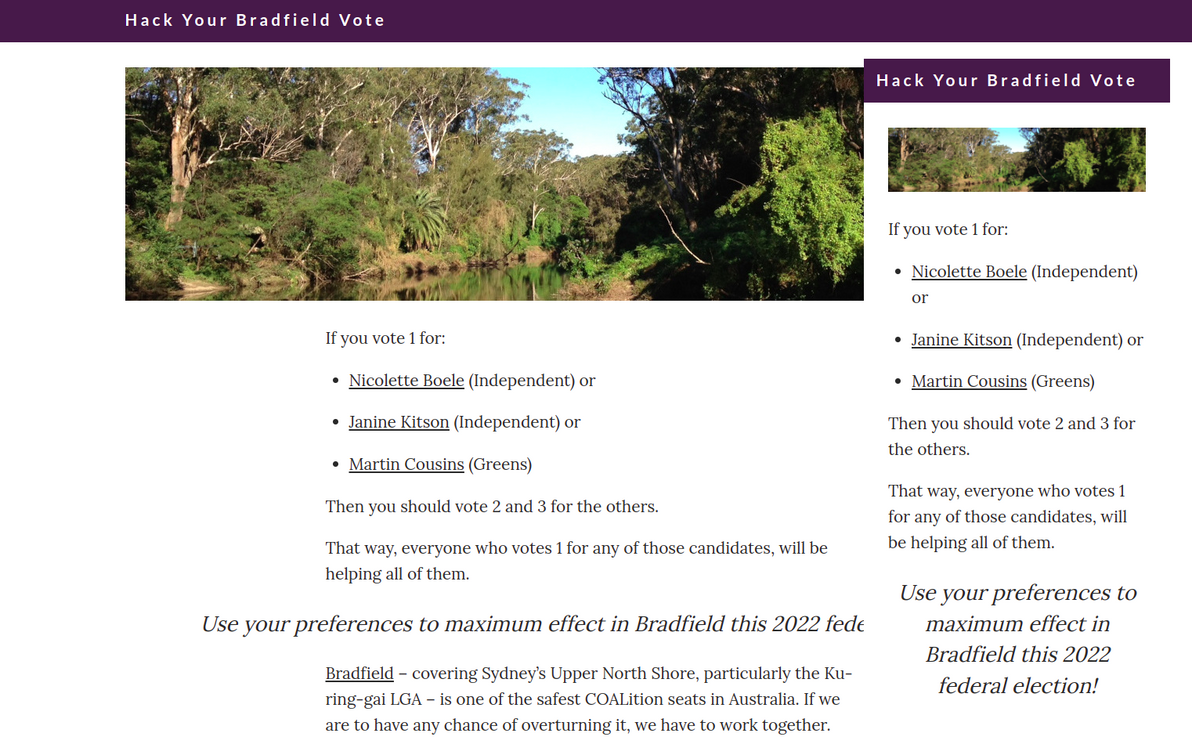
I built a tiny site, that I humbly hope makes a tiny difference in my home electorate of Bradfield, this 2022 federal election. Check out Hack Your Bradfield Vote.
How "Hack Your Bradfield Vote" looks on desktop and mobile
I'm not overly optimistic, here in what is one of the safest Liberal seats in Australia. But you never know, this may finally be the year when the winds of change rustle the verdant treescape of Sydney's leafy North Shore.
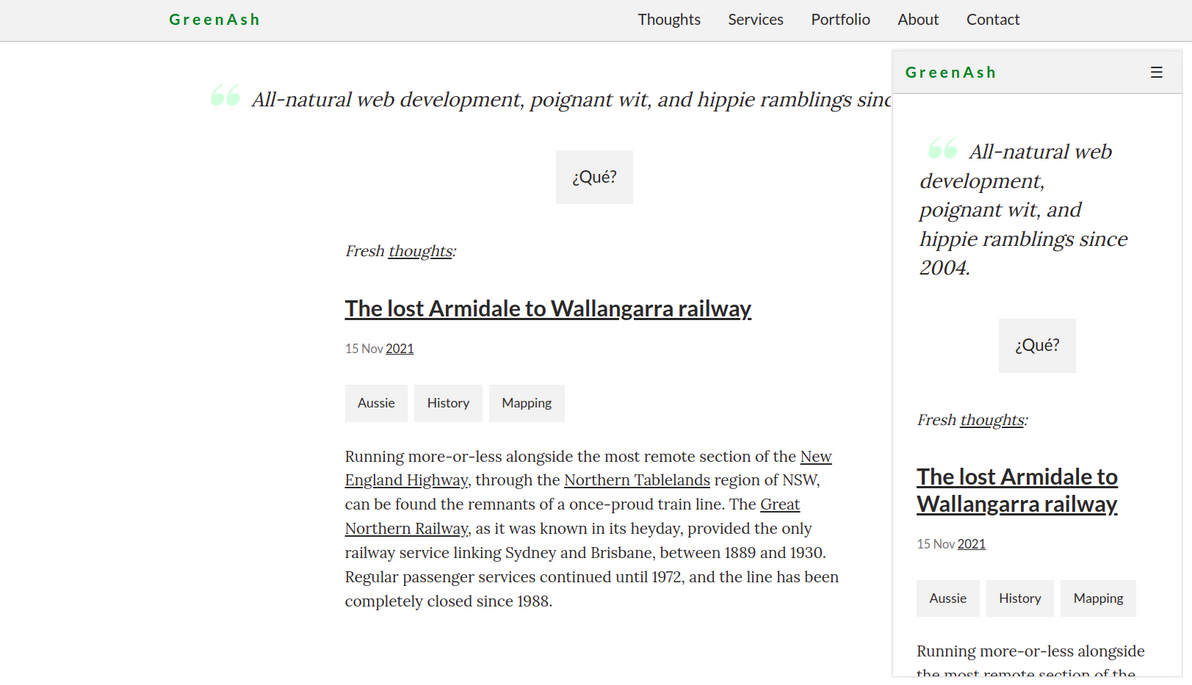
As was the case with v4, this new version isn't a complete redesign, it's a realign. First and foremost, the new design's aim is for the thought-reading experience to be a delightful one, with improved text legibility and better formatting of in-article elements. The new design is also (long overdue for GreenAsh!) fully responsive from the ground up, catering for mobile display just as much as desktop.
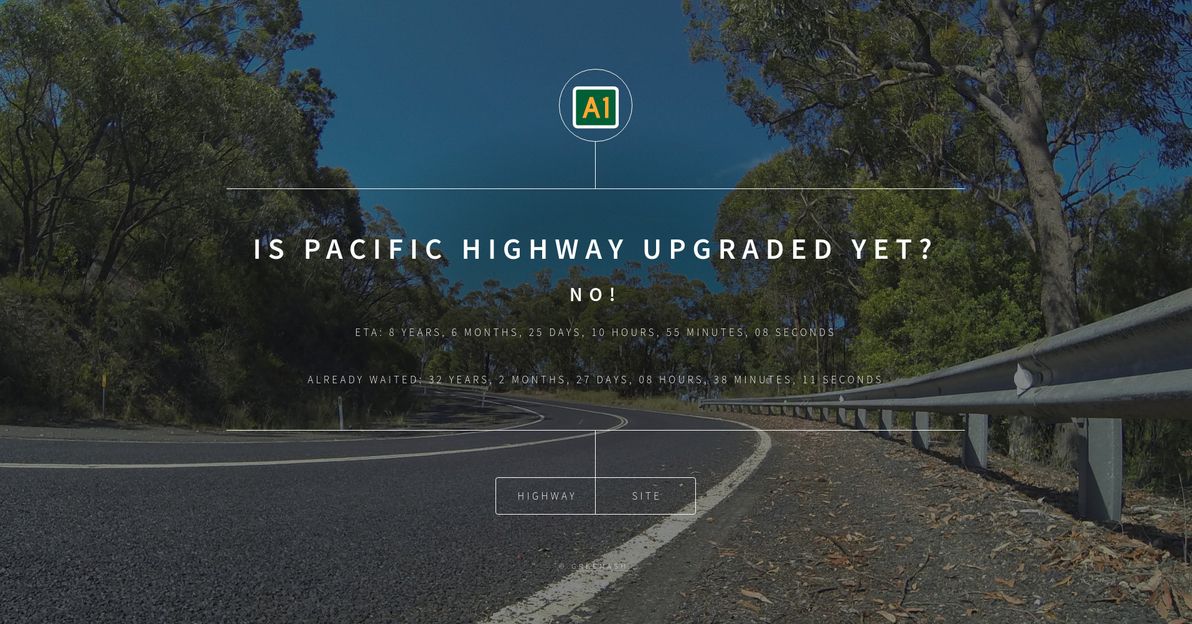
I got thinking about this, in light of the government's announcement at the end of 2020 that the Pacific Highway upgrade is finished. I was like, hang on, no it's not! How about a web site to tell people how long we've already been waiting for this (spoiler alert: ages!), and how much longer we'll probably be waiting?
Complete with a countdown timer, which is currently set to 1 Jan 2030, a date that I arbitrarily and fairly optimistically picked as the target completion date of the Hexham bypass (but that project is still in the planning stage, no construction dates have currently been announced).
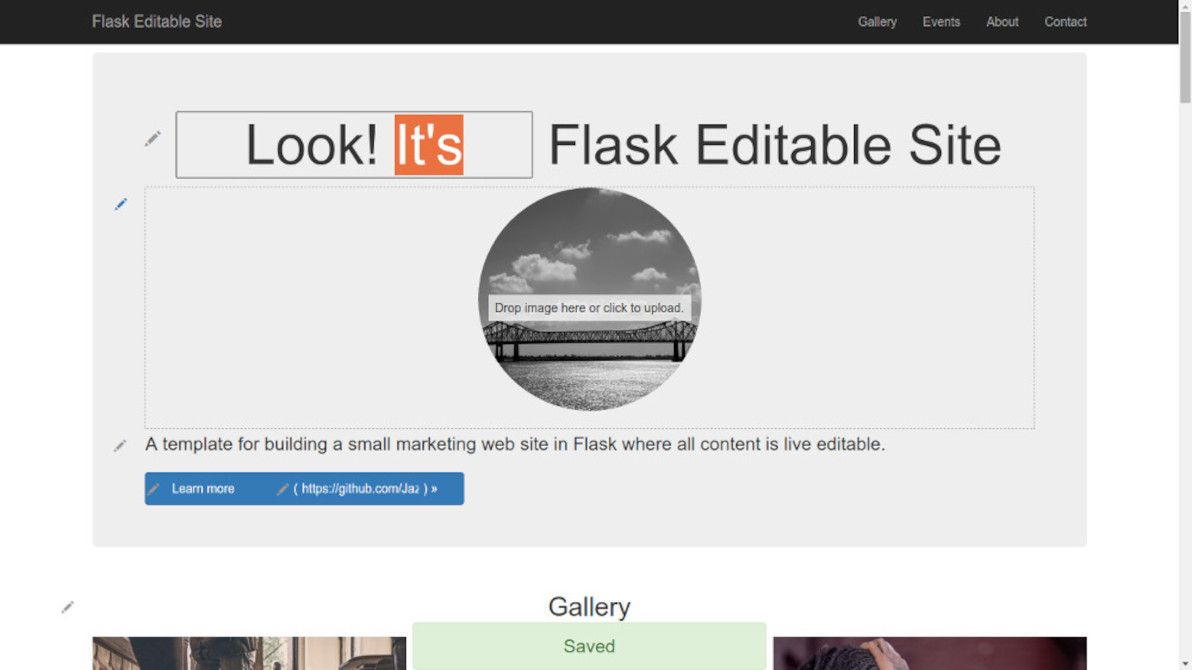
Text and image block editing with Flask Editable Site.
The aim of this app is to demonstrate that, with the help of modern JS libraries, and with some well-thought-out server-side snippets, it's now perfectly possible to "bake in" live in-place editing for virtually every content element in a typical brochureware site.
This app is not a CMS. On the contrary, think of it as a proof-of-concept alternative to a CMS. An alternative where there's no "admin area", there's no "editing mode", and there's no "preview button". There's only direct manipulation.
"Template" means that this is a sample app. It comes with a bunch of models that work out-of-the-box (e.g. text content block, image content block, gallery item, event). However, these are just a starting point: you can and should define your own models when building a real site. Same with the front-end templates: the home page layout and the CSS styles are just examples.
Adding image fields to a Django model is easy, thanks to the built-in ImageField class. Auto-resizing uploaded images is also a breeze, courtesy of sorl-thumbnail and its forks/variants. But what about embedding resized images inline within text content? This is a very common use case for bloggers, and it's a final step that seems to be missing in Django at the moment.
Having recently migrated this site over from Drupal, my old blog posts had inline images embedded using image assist. Images could be inserted into an arbitrary spot within a text field by entering a token, with a syntax of [img_assist nid=123 ... ]. I wanted to be able to continue embedding images in roughly the same fashion, using a syntax as closely matching the old one as possible.
So, I've written a simple template filter that parses a text block for tokens with a syntax of [thumbnail image-identifier], and that replaces every such token with the image matching the given identifier, resized according to a pre-determined width and height (by sorl-thumbnail), and formatted as an image tag with a caption underneath. The code for the filter is below.
autop is a script that was first written for WordPress by Matt Mullenweg (the WordPress founder). All WordPress blog posts are filtered using wpautop() (unless you install an additional plug-in to disable the filter). The function was also ported to Drupal, and it's enabled by default when entering body text into Drupal nodes. As far as I'm aware, autop has never been ported to a language other than PHP. Until now.
In the process of migrating this site from Drupal to Django, I was surprised to discover that not only Django, but also Python in general, lacks any linebreak filtering function (official or otherwise) that's anywhere near as intelligent as autop. The built-in Django linebreaks filter converts all single newlines to <br /> tags, and all double newlines to <p> tags, completely irrespective of HTML block elements such as <code> and <script>. This was a fairly major problem for me, as I was migrating a lot of old content over from Drupal, and that content was all formatted in autop style. Plus, I'm used to writing content in that way, and I'd like to continue writing content in that way, whether I'm in a PHP environment or not.
Therefore, I've ported Drupal's _filter_autop() function to Python, and implemented it as a Django template filter. From the limited testing I've done, the function appears to be working just as well in Django as it does in Drupal. You can find the function below.
What can I say? It's been a while. I was bored. The old site and the old server were getting crusty. And my technology preferences have shifted rather dramatically of late. Hence, it is with great pride that I present to you the splendiferously jaw-dropping 4th edition of GreenAsh, my personal and professional web site all rolled into one (oh yes, I love to mix business and pleasure).
Fat-Free is a brand-new PHP framework, and it's one of the coolest PHP projects I've seen in quite a long time. In stark contrast to the PHP tool that I use most often (Drupal), Fat-Free is truly miniscule, and it has no plans to get bigger. It also requires PHP 5.3, which is one version ahead of what most folks are currently running (PHP 5.3 is also required by FLOW3, another framework on my test-drive to-do list). A couple of weeks back, I decided to take Fat-Free for a quick spin and to have a look under its hood. I wanted to see how good its architecture is, how well it performs, and (most of all) whether it offers enough to actually be of use to a developer in getting a real-life project out the door.
I'm going to be comparing Fat-Free mainly with Django and Drupal, because they're the two frameworks / CMSes that I use the most these days. The comparison may at many times feel like comparing a cockroach to an elephant. But like Django and Drupal, Fat-Free claims to be a complete foundation for building a dynamic web site. It wants to compete with the big boys. So, I say, let's bring it on.
Last weekend, I attended Social Innovation Camp Sydney 2010. SiCamp is an event where several teams have one weekend in which to take an idea for an online social innovation technology, and to make something of it. Ideally, the technology gets built and deployed by the end of the camp, but if a team doesn't reach that stage, simply developing the concept is an acceptable outcome as well.
I was part of a team of seven (including our team leader), and we were the team that built Refugee Buddy. As the site's slogan says: "Refugee Buddy is a way for you to welcome people to your community from other cultures and countries." It allows regular Australians to sign up and become volunteers to help out people in our community who are refugees from overseas. It then allows refugee welfare organisations (both governmnent and independent) to search the database of volunteers, and to match "buddies" with people in need.
Of the eight teams present at this OzSiCamp, we won! Big congratulations to everyone on the team: Oz, Alex, James, Daniela, Tom, (and Jeremy — that's me!) and most of all Joy, who came to the camp with a great concept, and who provided sound leadership to the rest of us. Personally, I really enjoyed working on Refugee Buddy, and I felt that the team had a great vibe and the perfect mix of skills.
After much delay, the stylish new 3rd edition of GreenAsh has finally hit the web! This is the first major upgrade that GreenAsh has had in almost 2 years, since it was ported over from home-grown CMS (v1) to Drupal (v2). The site has been upgraded from its decaying and zealously hacked Drupal 4.5 code base, to the latest stable (and much-less-hacked) 4.7 code base. It sports a snazzy new theme, complete with fresh branding, graphics, and content layout. It is using quite a few new modules that are only available in more recent versions of Drupal, including views, pathauto, and the improved captcha module. And, best of all, it has finally been switched over to the category module, which was built and documented by myself, and which had the purpose from the very beginning of being installed right here, in order to meet the hefty navigational and user experience demands that I have placed upon this site. Read on to find out how, and why, the upgrade in all its pain and glory was carried out.